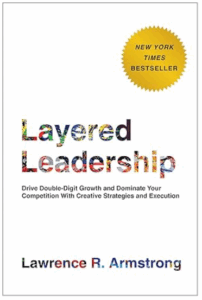
 Lawrence R. Armstrong
Matt Holt Books (2025)
ISBN: 978-1637746356
Reviewed by Scott Hall for Reader Views (01/2026)
In his alliteratively titled book, Layered Leadership, Lawrence R. Armstrong lays out the success, history, and leadership techniques of Ware Malcomb, an industrial design firm. Armstrong maps his journey into three parts. Along the way, he weaves in his artistic approach to layering subjects. He takes us from a foundational approach to the advanced concepts of driving financial growth. Armstrong pays close attention to maintaining and growing a strong corporate culture. According to the author, “Layers are a metaphor, a methodology, and a framework for synthesizing the vast amount of knowledge required for our lives and work.”
He uses layering as a conceptual way to think about business. Throughout Layered Leadership, the author puts in some graphic images and artwork completed by himself to juxtapose text and show the concept of how layers are synthesized across life and business itself. He periodically dips into nostalgic vignettes from the founders, Bill Ware and Bill Malcomb, whom he refers to as Bill and Bill throughout the book.
Armstrong’s self-account of leadership leads him to some self-discovery where he says, “Finding the leader within you at some point requires betting on yourself and your abilities.” Armstrong toggles between risk-taking and cutting a new path with authenticity that is different from the company’s competitors. He draws inspiration from some genius personalities, such as Leonardo Da Vinci, and speaks about how these personalities extracted forward direction and vision from non-linear activities. He suggests a broad approach to business acumen with a strong supporting scaffolding in and around curiosity. He suggests having fluency in different subjects, from Profit & Loss (P&L) to leading others, rather than trying to be a pinnacle expert.
The author tells us that a constant-growth mindset plays a key role in business success and getting to the next level of profitability. He suggests a strong mentoring approach to groom and prepare new leadership rather than just having a senior executive hang on until the end. He makes a good point about mentorship pairing with non-direct reports to ensure honest and open feedback occurs. He emphasizes dealing with customer issues sooner rather than later or before they become contentious.
True to its name, Layered Leadership: Drive Double Digit Growth and Dominate Your Competition with Creative Strategies and Execution, it spends some white space talking about preparing financial statements and suggests that all executives should keep an eye on their assets and liabilities, along with setting measurable goals. The author suggests his fellow executives keep on a path to financial stability and ensure they are prepared to navigate difficult business periods such as the Covid-19 shutdown and other historical moments that impacted his industry, even suggesting that executives prepare themselves to forgo their own salaries during lean times to protect the workforce.
Layered Leadership also makes use of several metaphorical models, such as the Road Runner and Coyote cartoon, to represent business development versus business operations regarding their speed of movement. Other models, such as the ‘Ultimate Ware Malcom vision,’ come off as a little more contrived in nature. Still, there are other models employed, such as the Visible Light Spectrum framework that draws from academia and indirectly maps to diversification and acquisition strategies that are helpful.
The author finishes with sage advice on succession planning for senior leaders. In some areas, the author hits his target, while in a few sections, it seems a little aspirational and tangential to bring it all together, outside of a particularly skilled person. He strives to merge art, business, and strategy into one easy-to-read book. It is ideal reading for young managers and soon-to-be senior leaders.
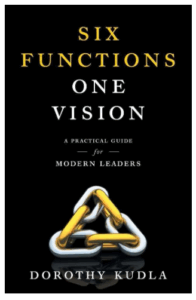
Dorothy Kudla
Lioncrest Publishing (2025)
ISBN: 978-1544546957
Reviewed by Scott Hall for Reader Views (01/2026)
In Six Functions, One Vision: A Practical Guide for Modern Leaders, Dorothy Kudla gives us an umbrella-style approach to leadership and its supporting foundations. As the name suggests, Six Functions, One Vision, lays out six distinct functions within a framework that support each function. Students of business will recognize the cadence of defining a vision, setting expectations, dealing with motivation, building talent, cultivating collaboration, and ultimately performing.
Throughout the book, Kudla weaves in a variety of tools to help the reader understand, all while practicing each of the functions. She provides tactical-level advice by asking probing questions to help managers make sense of the scenarios they are encountering. She couples the functions to real business areas, such as marketing, in order to get readers to think about how they can change their thinking. One such area was cross-pollination, or planning in a different functional area than the employees are used to working in. She highlights the approach here, saying, “Asking people to think about marketing more broadly is especially effective at getting the team to think outside of their own functional and organizational bubble, which can generate different, more innovative ideas.”
The author builds the basic scaffolding for personality assessments as a way to map behaviors and elucidate how individuals can be best aligned with the work at hand. She puts together a helpful guide for the reader to learn how to recognize the difference DISC styles. For those who are not familiar with it, the DISC personality assessment is a popular personality tool that measures behavior styles across four traits: dominance, influence, steadiness, and conscientiousness. Business management readers will immediately recognize its close relation to the Myers-Briggs test, as well as other tools such as the enneagram and 4-color theory tests. Each chapter comes with a helpful summary at the end.
Six Functions, One Vision works to hold up the functions with what the author calls pillars. The pillars include self-awareness, situational awareness, and intentional action. She adds sample dialog to each area that helps readers see typical complaints and how to handle them. She deftly handles a chapter on motivation, including the psychology of intrinsic versus extrinsic motivation, without making the reader feel like they are reading one of their old management 101 textbooks. She posits,
Motivation isn’t one-size-fits-all. Each person is driven by different factors—what ignites one person might not even spark interest in another. That’s why it’s crucial for leaders to take the time to truly understand what makes their team members tick. You need engagement and motivation together.
This leads to a chapter about developing employees. She encourages readers and aspiring leaders to develop a dual-track mindset of thinking. Kudla says, “I encourage leaders to develop a dual-track mindset when interacting with others and focus on two aspects of the conversation: (1) what the conversation is about and (2) how the conversation is unfolding..”
The author is careful not to veer into the usual business terms and well-worn clichés. She takes the time to break things into their very basic definitions, such as function, into a set of related actions. She uses these and other business axioms to help build out a case for coaching, investing, and ultimately leading others. Both advanced and beginning managers will find Six Functions, One Vision interesting and an easy read.

Shaine Hobdy
Independently Published (2025)
ISBN: 979-8285309369
Reviewed by Scott Hall for Reader Views (12/2025)
In Coach To ALIGN: Building Empowered Teams Together the author, Shaine Hodby, articulates a framework that is designed to help managers become better leaders. It could be read concurrently and would make an excellent supplement to a week-long management workshop. The book is geared towards leaders and is designed to give them the tools to create a productive work environment.
Hobdy starts by mapping and explaining four critical personality types: feeler, thinker, controller, and entertainer. The idea is to help each team member understand the unique communication styles of their fellow workers. The author dives into how to recognize these diverse personalities as well as how they interpret and learn new things.
The book comes with extended information and a helpful personality calculator on the author’s website that calculates the personality type and the individual’s dominant traits. There are some similarities to color theory typing based on the work of Psychologist Dr. Carl G. Jung. The secret, of course, is identifying the personality type and Hobdy speaks to this throughout his book. He spends a significant amount of the book speaking about how to coach each of the four personality types so they can reach optimal performance.
The author includes helpful sample statements and questions to ask as well as walking through what is called the SMART goal criteria. It is about changing the culture and creating a culture of innovation and learning. At the end of each personality chapter, the author puts a handy matrix so employees can align their communication styles with those of differing types.
After thoroughly breaking down the personality types, the author dives into what is called the ALIGN Coaching model. The model, as the reader might expect, does align to an acronym. Hobdy also provides worksheets at the end of these chapters that help check off the different approaches to developing employees. He calls it the ALIGN Coaching Roadmap. According to the author, “It ensures that leaders can address each employee’s distinct developmental needs, making coaching more responsive and relevant.”
Coach To ALIGN works at getting to the root cause of behavior performance by suggesting who, what, when, why type of activities that are designed to bridge the gap between expected performance and actual performance. In the book, the author speaks about how an employee’s actual performance must align with measurement and manager agreed-to performance. Along the way the author provides helpful coaching and feedback discussion questions to help map the expected versus actual performance gap. Hobdy provides both qualitative and quantitative suggestions and includes some analysis measurement recommendations.
The author demonstrates the flexibility of the Coach To ALIGN framework as he speaks about On The Spot ALIGNment or OTSA and the ability to make immediate feedback adjustments. He deftly speaks about diversity in learning and how when we teach others, we are reinforcing our own understanding.
The Coach To ALIGN model and framework provides a helpful guidebook for employees and managers to engage with one another. Coach To ALIGN ultimately covers so much ground but remains conscious that how we learn is custom to each of us.